

What is flexographic printing?
Flexographic printing, also known as flexo printing, is a versatile, high-speed printing process that utilises flexible relief plates, or photopolymer printing plates, to transfer ink onto various substrates.

The flexo process first came to prominence in the late 19th century and is commonly used for packaging materials, labels, newspapers, and other such applications. The process can involve as few as 4 colours / print stations, or as many as 12, depending on the configuration of the OEM press.
Modern flexo printing presses can often run at speeds up to 400 metres per minute, and the process is usually used for long runs where high volumes are required in a shorter timeframe.
The flexo process
The process involves mounting flexible printing plates onto cylinders, which rotate and transfer ink onto the substrate, often a web, as it is fed through the plate system.
On a typical flexo press, there are 4 roller types:
- A fountain roller;
- An anilox roller;
- A plate cylinder or flexo plate; and,
- An impression cylinder.

The fountain roller moves the ink from the ink tray to the anilox roller. The anilox roller, which has engraved cells, transfers the ink to the plate cylinder, often known as the flexo plate. Often a doctor blade is used prior to this, to ensure that the only ink delivered to the plate cylinder is the ink within the engraved cells.
From there, the impression cylinder applies pressure to the flexo plate to ensure that the image is transferred to the substrate. The substrate or web is then fed through the drying section of the machine, which is plate-less.
There are several drying methods used in flexographic printing, and the drying method itself is dependent on the ink used. The main ink types are:
- Ultraviolet (UV) curing inks;
- Water-based inks;
- Solvent-based inks; and,
- Electron-beam curing inks.
At GEW, we provide mercury arc UV and UV LED systems to cure UV curing inks – this form of curing is now the industry standard. To find out more about our UV curing systems for flexo printing, go here.
Applications of flexographic printing
Flexographic printing is used across a wide range of industries to print a range of materials, but it also covers numerous printing formats, such as:
- Narrow web printing
- Mid web printing
- Wide web printing
- Stack press
- CI (central impression) printing
Below is a list of flexograhic products that fall under this range of formats:
Labels & tags
- Pressure‑sensitive labels
- Wraparound labels
- In‑mould labels
- Shrink sleeves
- Tags and tickets
- Security and variable‑data labels (often hybrid with digital)
Flexible packaging
- Snack food packaging
- Confectionery wrappers
- Frozen food packaging
- Pouches and sachets
- Stand‑up pouches
- Retort packaging
- Lidding films
- Medical and pharmaceutical flexible packs
Rigid packaging
- Folding cartons (especially for short to mid runs)
- Corrugated pre‑print and post‑print
- Paper cups and containers
- Paper bags and sacks
Specialty applications
- Gift wrap
- Wallpaper
- Envelopes
- Lottery tickets
- Security features (when combined with screen or digital)
- Metallic and tactile effects (via UV varnishes, cold foil, etc.)
Food & beverage packaging
- Bottle labels
- Beverage multipack wraps
- Dairy lids
- Bread bags
- Produce packaging
- Meat and cheese wraps
Household & personal care
- Detergent labels
- Cosmetic and toiletry packaging
- Cleaning product wraps
- Wet‑wipe packaging
Industrial & technical applications
- Release liners
- Adhesive tapes
- Industrial films
- Chemical drum labels
- Automotive component labels
Retail & Logistics
- Barcoded shipping labels
- Shelf‑edge labels
- Price tags
- RFID‑integrated labels
If you’re a flexographic printer looking to retrofit UV arc, UV LED or both technologies to your press to improve your printing processes, then contact our sales team below to find the best solution for you.
Benefits of UV arc and UV LED flexo printing
For many flexo printers, UV curing has been a staple of their work for many years, particularly in narrow web and mid web flexo formats. Recent years have seen the shift to UV LED curing in the market, with many printers enjoying the benefits offered by the newer technology.
There are many benefits to UV flexo printing when compared to traditional printing:
Benefits of mercury UV curing
- Instant curing compared to solvent or water‑based systems, enabling higher press speeds.
- Sharper dots and finer detail because UV inks don’t absorb into the substrate.
- Improved colour density and gloss levels.
- Better adhesion across a wide range of substrates, including films and foils.
- Reduced dot gain and more consistent print results.
- Less downtime due to faster job changeovers – no drying adjustments needed.
- Lower waste because UV inks stay open on the press and don’t dry in the anilox.
- More stable viscosity since UV inks don’t evaporate.
- Broad ink compatibility, including opaque whites, metallics, varnishes, and adhesives.
- Works well with heat‑sensitive substrates compared to hot‑air drying.
- Lower ink consumption due to higher pigment concentration.
- Lower energy cost than hot‑air drying, though still higher than LED.
- Established technology with wide availability of lamps, inks, and support.
Flexo examples


Benefits of UV LED curing
- Instant on/off curing – no warm‑up or cool‑down.
- Even more stable curing because LEDs deliver a consistent wavelength and intensity.
- Higher print quality on heat‑sensitive substrates due to dramatically lower heat output.
- Better control of opaque whites and high‑density colours thanks to deeper, more uniform curing.
- Significantly lower energy consumption – often 50-70% less than mercury arc.
- Long lamp life (30,000+ hours for AeroLED2) with minimal degradation.
- Reduced maintenance – no reflectors, shutters, or frequent lamp changes.
- Less downtime because LEDs don’t require warm‑up and don’t drift in output.
- No ozone generation, eliminating the need for extraction.
- No mercury, making it safer and more sustainable.
- Lower overall heat, improving operator comfort and reducing fire risk.
- Excellent for thin films, shrink sleeves, and temperature‑sensitive materials.
- Enables higher press speeds due to consistent curing.
- Compatible with a growing range of LED‑formulated inks and coatings.
GEW UV and UV LED curing systems for UV flexo printing
GEW is the leading manufacturer of UV and UV LED curing systems for flexographic printing applications. Our most suitable products for flexographic printing are our UV LED curing system, AeroLED2, and our world-renowned mercury arc UV curing system, E2C:
AeroLED2
AeroLED2 is a next generation, higher power UV LED system for full cure, printing, coating and converting applications up to 70cm wide; AeroLED2 offers a 30% increase in electrical power (67W / cm), a 30% increase in UV dose (170mJ / cm2) and a 40% increase in UV irradiance (26W / cm2) compared to its predecessor, AeroLED.
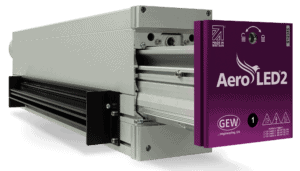
AeroLED2 is also ArcLED compatible. Using the same fan and ducting arrangement as the industry standard E2C, customers have total flexibility to switch between UV arc and AeroLED2 on any station. No filters are required due to the high redundancy, making maintenance a breeze. Moreover any customers with GEW’s RHINO/RLT power supply platform can upgrade to LED within a matter of hours, by simply changing the cassettes and running a software upgrade.
Following its predecessor, in an AeroLED2 system air is extracted by a single centralised fan sited away from the press. There is no need for integrated fans or electronics in the individual lampheads, which eliminates the high pitched noise and risk of failure that these bring.
AeroLED2 features the same LED chassis and core components as GEW’s LeoLED2 lamphead, for proven reliability. As with LeoLED2, the lamphead has tough watertight seals to protect the LED modules from ingress and to make cleaning easy and safe. Every aspect of the design has been carefully considered to deliver robust performance and long-term reliability.
E2C
E2C is GEW’s most popular UV dryer with over 43,000 units installed worldwide (July 2025). Fully air-cooled, it delivers unparalleled curing performance up to 140W/cm due to patented ultra-efficient reflector designs. No similar product delivers more curing performance at this energy level.

Perfect for use on any machine up to 60cm in width, E2C supports printing on the widest range of heat-sensitive materials because our actively air-cooled reflectors reduce heat transfer to the substrate. It also boasts GEW’s renowned quick-change cassette design enabling a new lamp to be fitted in under 2 minutes with only one hex key tool required.
Reliability is guaranteed and when powered by GEW’s RHINO system, E2C can be purchased with a 5-year warranty which means no unplanned maintenance costs well beyond the return on investment period.
E2C can be integrated and customised to fit a wide range of printing and coating machines. GEW’s experienced engineers will be happy to help understand your requirements further.
Patented ArcLED technology
All GEW mercury arc UV and UV LED products for flexographic printing processes are ArcLED compatible. This means that GEW’s power system allows you to seamlessly switch between the two technologies, just by changing the lamps.
This gives flexo printers ultimate flexibility over the printing process, meaning they can pick the technology most suitable for the print job at hand.
ArcLED also future-proofs the printing press, meaning that printers can upgrade to UV LED in their own time.
To see just how simple the ArcLED changeover is, watch the video below, which shows GEW’s E2C lamphead being swapped to a first-generation AeroLED lamphead, using an Allen Key.
See the simplicity of ArcLED, below.
GEW’s flexographic printing case studies
The case studies below illustrate the benefits our customers have enjoyed from switching to GEW’s UV curing systems:
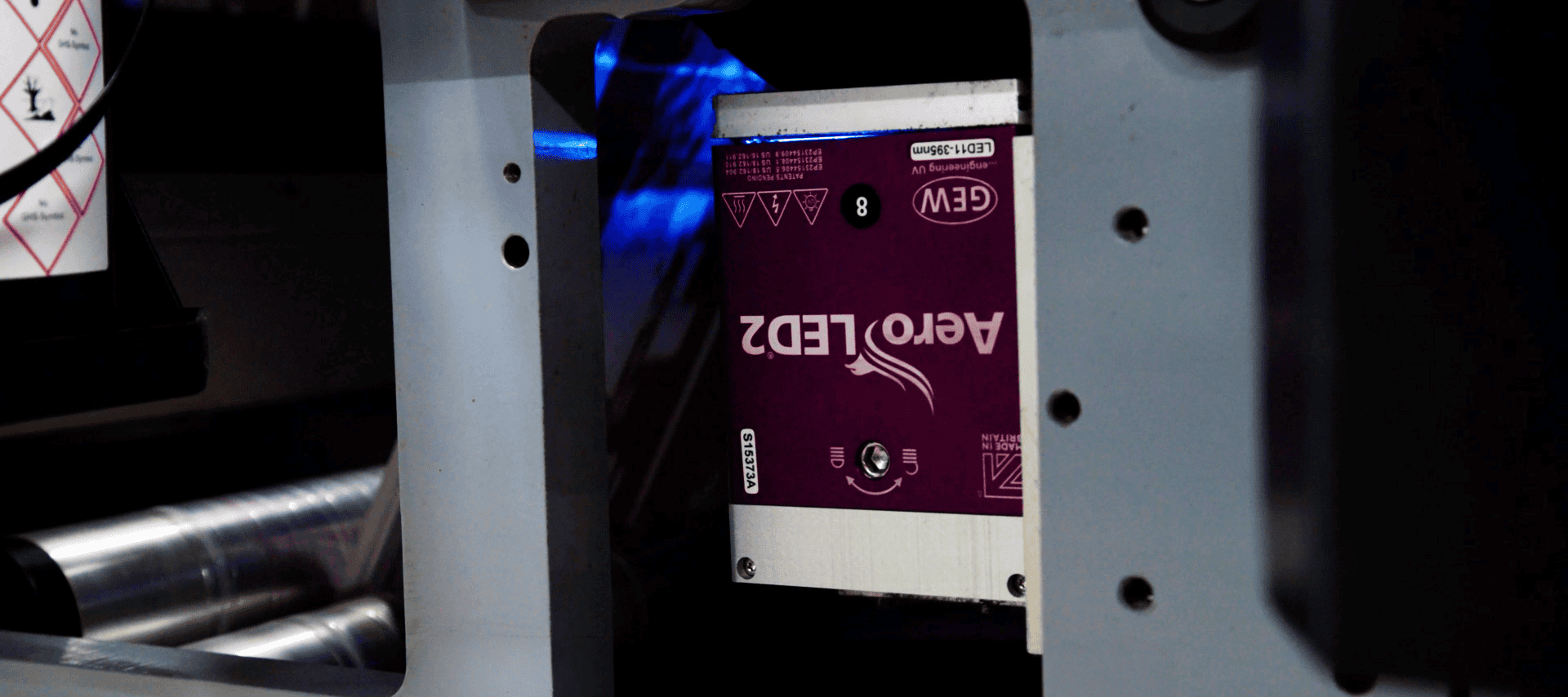
Geostick transition to UV LED in pursuit of sustainability

TDC chooses reliability and energy savings for better return on investment

Label Power’s AeroLED2 retrofit saves expensive $150,000 power grid upgrade
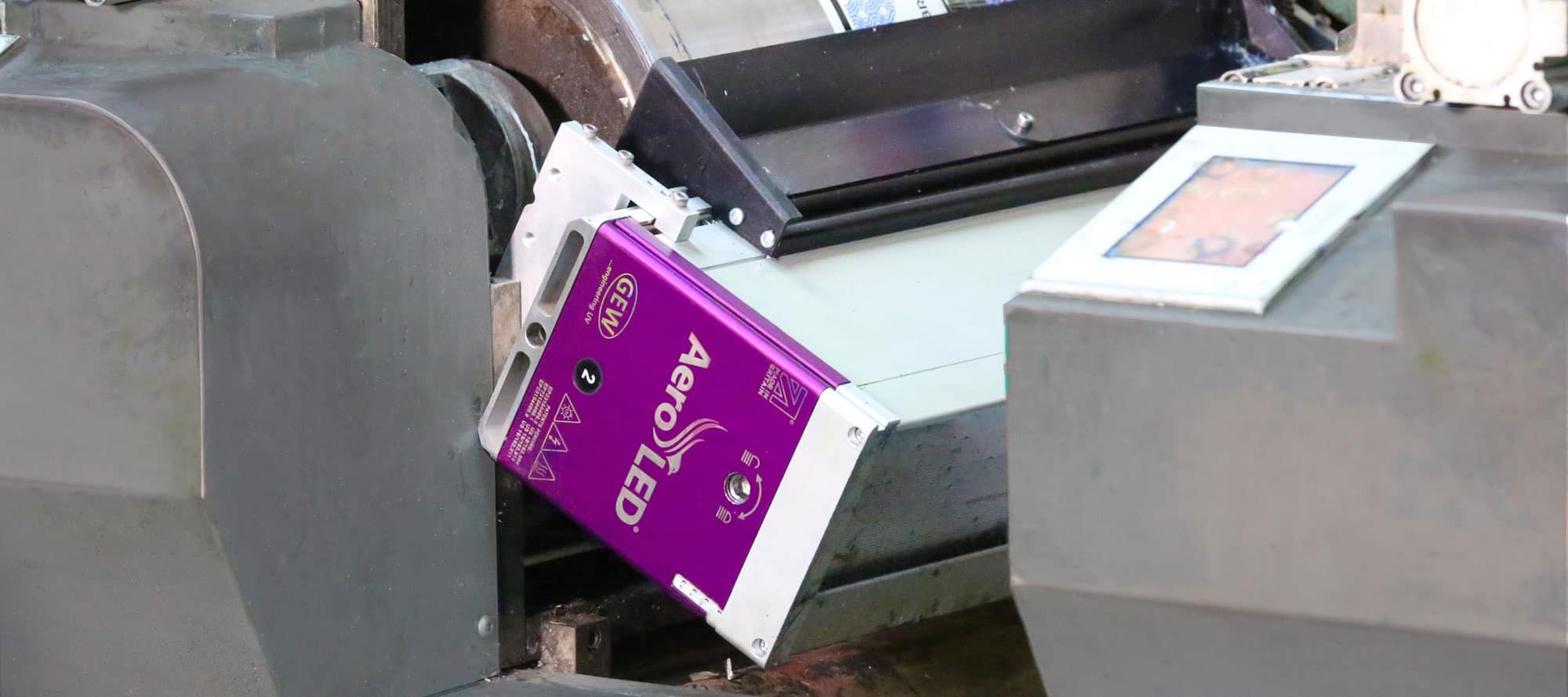
Clomark enjoy 18-20% reduction in energy consumption after switch to UV LED
Stic Image chooses AeroLED for sustainability, speed, simplicity and savings
Speak to our sales team
Speak directly to the most relevant Sales person below:

Region, International:
Marcus Greenbrook
Director, International Sales
Email Marcus directly


