

What is industrial furniture manufacturing?
Industrial furniture manufacturing is the large-scale, automated production of furniture destined for commercial and residential markets. This sector relies on industrial, high-speed machinery and advanced chemical coatings to produce thousands of units per day. These finished products are primarily sold to major global retailers, hospitality chains or corporate entities.
From a coating and curing perspective, we will focus on furniture created using wood substrates – such as solid wood, medium-density fibreboard (MDF), particleboard, and plywood – that require rapid processing and highly durable, aesthetically consistent surface finishes that allow for high-volume sales into retailers.
Furniture applications
The industrial furniture sector can be broadly categorised by the specific end-use environments of the products, including:
- Kitchen & bathroom cabinets: High-volume components requiring chemical resistance against moisture, steam, and household cleaning agents.
- Wardrobes & storage systems: Large-format flat panels processed on high-speed rolling or spray lines where surface consistency across batches is critical.
- Beds & bedroom furniture: Structural and aesthetic wood components that demand robust scratch resistance and durable topcoats.
- Children’s furniture: Specialised production lines requiring non-toxic, highly resilient finishes that withstand rigorous wear and tear.
- Tabletops and interior doors: High-wear surface areas requiring ultra-durable scratch resistance, consistent gloss control, and superior scratch protection to withstand heavy daily impact.

Benefits of UV curing for industrial furniture manufacturers
UV benefits
- Instant curing and processing: Unlike traditional curing within this sector, which can include extensive dwell time in massive ovens or stacking timber under protective sheds, UV curing polymerises coatings in a fraction of a second. This enables immediate stacking, packaging, and shipping right off the line, reducing work-in-progress (WIP) inventory.
- Significantly reduced factory footprint: Traditional drying tunnels require massive amounts of floor space. Compact UV lampheads – like GEW’s UV curing systems, which utilise a cassette profile – can be integrated into tight machinery spaces, freeing up highly valuable real estate on the production floor.
- Superior surface scratch and chemical resistance: UV-curable lacquers form highly cross-linked polymer networks. This provides the robust chemical and scratch resistance necessary to meet the stringent household wear-and-tear standards required for kitchen cabinets, wardrobes, and tables.
- Elimination of Volatile Organic Compounds (VOCs): UV-curable wood coatings are typically 100% solids formulations. By removing solvents from the process, manufacturers can eliminate harmful VOC emissions, simplify regulatory compliance, and create a safer, healthier breathing environment for factory personnel.
- Consistent, high-speed production: UV systems deliver repeatable, high-intensity output that supports the fast line speeds demanded by high-volume automated rolling and spray lines.
UV LED benefits
- Energy and cost reductions
- Over 65% energy savings compared to UV arc lamps.
- Over 55% lower electrical mains capacity, freeing up factory power infrastructure.
- Instant on/off – Unlike mercury arc lamps that require a warm-up and cool-down period, UV LEDs turn on and off instantly at full power.
- Most effective handling of heat-sensitive wood substrates
- Minimal substrate heat transfer: Mercury lamps emit substantial infrared (IR) heat, whereas UV LEDs emit a narrow-band wavelength that leads to less heat on the substrate. This prevents thin wood veneers from warping, prevents resin / pitch bleed in resinous softwoods, and reduces the pressure on the thermoplastic glue, keeping the surface nearly unaffected by heat.
- Reduced material and paint waste: By eliminating excessive heat from the drying process, converters can minimise warping and defects.
- Stable and uniform energy output across the entire lamp width, ensuring homogeneous gloss and colour.
- LED systems require less space compared to standard dryers or ovens.
- Long lifespan and minimised maintenance position UV LED curing technology as the future of the industrial wood coating and finishing market.
- Meeting international regulations
- Meeting corporate sustainability mandates from global retailers. Utilising UV LED technology lowers manufacturers’ carbon footprint, helping to secure their status as preferred sustainable vendors.
- Futureproofing against mercury legislation changes.
- Zero ozone generation.
GEW products for furniture lines
LeoLED2
From kitchen cabinets and wardrobes to children’s bedroom furniture, GEW’s LeoLED2 water-cooled UV LED curing system is engineered to solve the unique production challenges of the modern woodworking industry. LeoLED2 offers the power needed for fast furniture lines, offering a 55% increase in electrical power and a 50% increase in UV dose compared to previous generations, but it also offers the sustainability benefits that many converters crave.
Below, we outline the challenges the furniture market faces and explain how LeoLED2 helps to solve these for converters:
The challenge: Increasing utility costs
Traditional thermal drying tunnels and conventional mercury arc systems consume large amounts of electricity, directly squeezing your profit margins. Upgrading to LeoLED2 delivers typical energy savings of over 65% compared to conventional UV setups, for example.
The electrical efficiency of LEDs also drops your overall line power requirements. Its instant on/off capabilities mean energy is only consumed when a furniture panel is passing beneath the lamphead – eliminating idle power draw during line stoppages, adjustments, or shift changes.

The challenge: Retailer sustainability mandates
Global retail giants are actively enforcing strict green manufacturing mandates, pushing their global supply chains to eliminate carbon emissions, eradicate VOCs, and adopt sustainable technologies. If you cannot comply, you risk losing major corporate contracts. Installing LeoLED2 on your line ensures furniture converters are compliant with these demands.
The challenge: Substrate damage & waste due to excessive heat
High-intensity mercury lamps emit infrared heat. On furniture lines running heat-sensitive materials – such as thin natural wood veneers, resinous softwoods, or medium-density fibreboard (MDF) – excessive heat causes wood warping, resin bleed, and lacquer blistering, resulting in high reject rates and material waste. LeoLED2 solves this issue by eliminating infrared heat as it cures in the narrow band range (365nm, 385nm, 395nm and 405nm), without losing the curing power needed to develop high-class furniture at speed.
The challenge: Achieving premium aesthetics
Whilst styles and fashions change, the need for matte and soft-touch finishes on wardrobes and cabinets is likely to continue. Achieving this at high line speeds using traditional matting agents can compromise the scratch and stain resistance of the topcoat. LeoLED2 functions as the perfect, high-power pre-gelling source when paired with GEW’s ExciRay Excimer curing system. By utilising a 395nm LeoLED2 lamp to partially cure and lock in the lacquer’s base viscosity, the substrate is perfectly prepped for the ExciRay 172nm vacuum UV radiation to microfold the surface. This creates an ultra-deep matte, highly durable surface.
E4C
Industrial furniture manufacturing is a high-volume world, and delivering flawless, high-durability surfaces is non-negotiable. Whether you are an OEM designing next-generation automated coating machinery or a factory manager looking to optimise a high-speed finishing line, surface curing impacts your factory’s capacity potential.
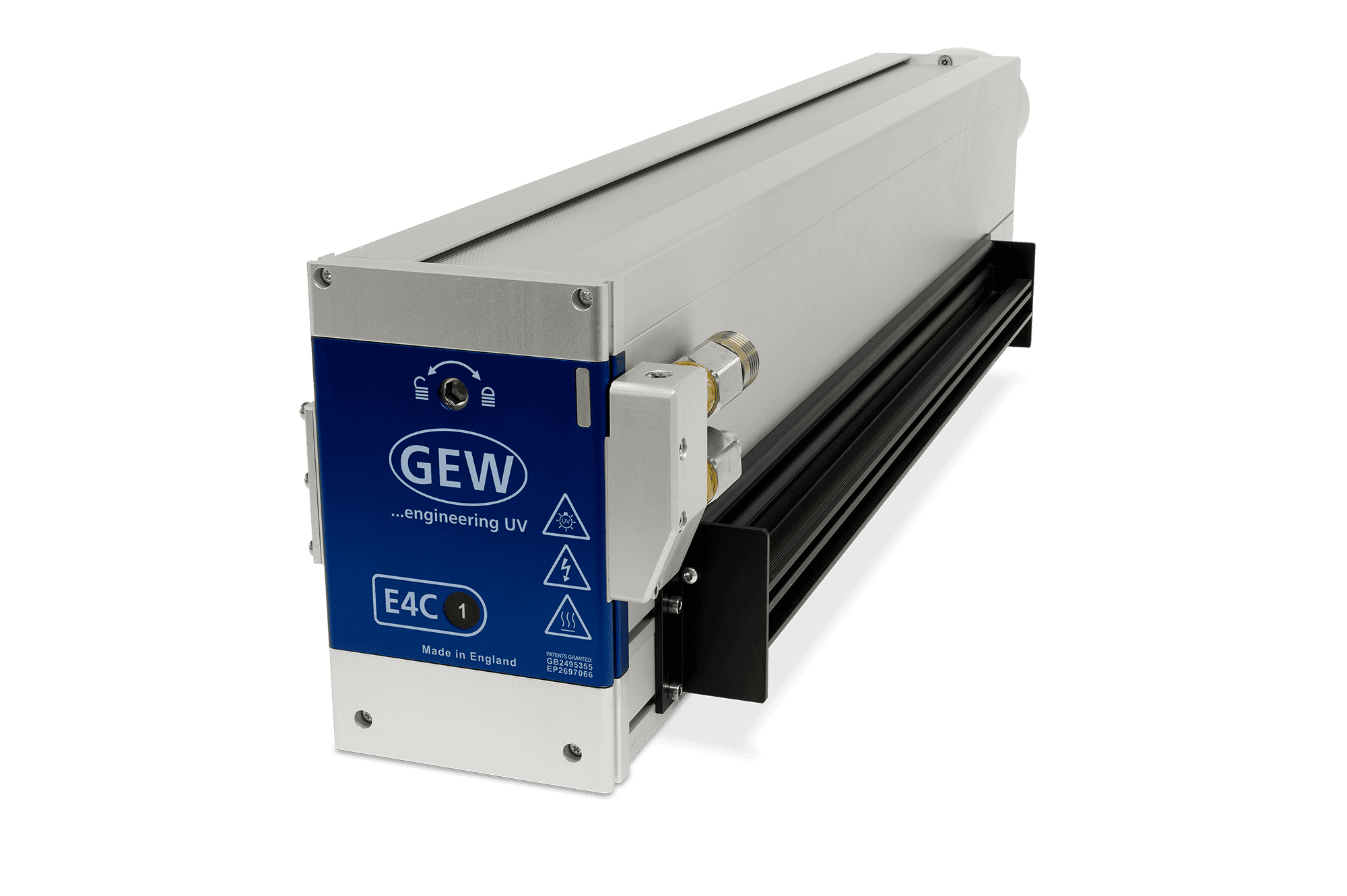
From kitchen cabinets and wardrobes to children’s bedroom furniture, tabletops, and interior doors, our water-cooled UV arc curing system, E4C, is engineered to solve the most demanding production challenges in the woodworking industry.
The challenge: Demanding chemistry & low-migration industrial coatings
High-speed wood coating lines often run heavy, highly pigmented topcoats or low-migration chemistry that requires powerful UV curing systems to achieve complete through-cure. Standard, low-power arc lamps frequently fail scratch or chemical resistance tests, forcing lines to slow down. E4C is GEW’s most powerful UV curing lamp, offering a UV dose of 220mJ / cm2. This dose ensures deep penetration through thick clear coats, heavily pigmented primers, and dense wood lacquers, passing the harshest cure test procedures with ease. E4C also supports the fastest line speeds.
The challenge: The energy drain from older thermal and UV lines
Many woodworking factories rely on massive thermal drying tunnels or inefficient legacy UV systems that run at full power continuously, sending utility costs soaring. E4C has been refined to operate with electrical efficiency. Combined with optically tuned reflectors that maximise curing power, the system utilises fast-start lamp technology to reduce unnecessary power draw.
The challenge: Heat-induced substrate damage & material waste
High-powered mercury lamps inherently emit infrared heat, which cab cause numerous issues on the substrate. Whilst LeoLED2 solves this entirely, E4C offers a mercury-based solution, with its integrated, water-cooled reflectors. While the lamp delivers maximum UV intensity downward, the water-cooled backing absorbs the infrared heat, strictly limiting heat transfer to the wood substrate.
ArcLED compatibility for furniture lines
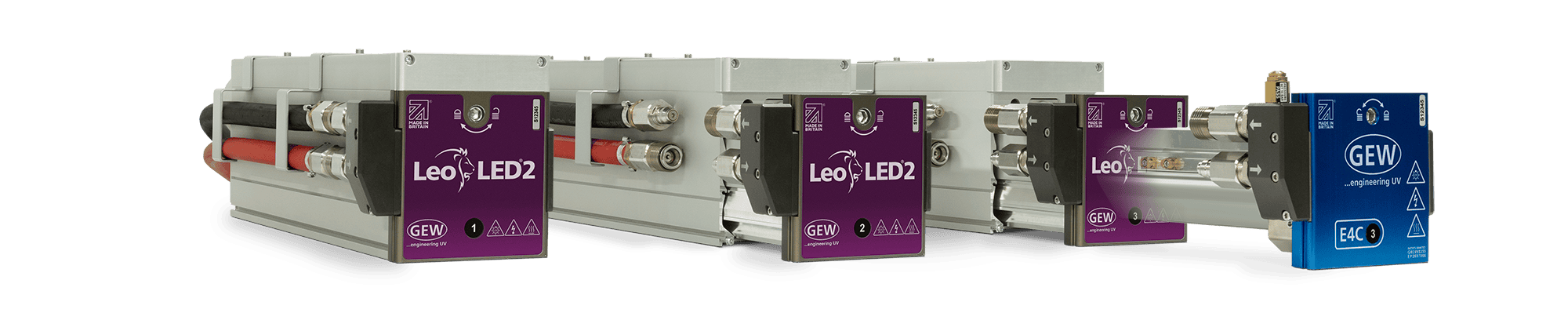
LeoLED2 and E4C, GEW’s mercury arc solution for furniture manufacturers, are both ArcLED compatible.
With GEW’s ArcLED, you can switch seamlessly between mercury arc and LED technologies. Both arc and LED cassettes are compatible with the same power supply and fit in the same housing for ease of change.
For furniture manufacturers looking to continue with mercury arc UV curing in the short term, but who would like to future-proof their press with UV LED, GEW’s patented ArcLED technology offers a viable solution that can be implemented at the converter’s pace.
To find out more, download our brochure below:
Watch our furniture case study
BJS are a furniture manufacturer based in the Czech Republic. They focus on continuous innovation and advancement, which has led to the introduction of a new, state-of-the-art wood coating line that combines soft-roller coating technology and UV LED curing.
Watch the case study video below to see why they switched to GEW’s LeoLED curing systems:
Speak directly to our sales representative
If you are an industrial furniture manufacturer looking to make your line more energy efficient, then speak to our team today about our world-renowned UV arc and UV LED curing systems:

Region, International:
Justas Žvikas
Sales Representative, Wood Coating
Email Justas directly
