

What is floor manufacturing?
Broadly speaking, flooring is any permanent covering applied over a floor structure to provide a walking surface. In the industrial manufacturing context, it refers to the diverse range of materials – from natural wood to advanced synthetics – that require specialised surface treatments to ensure durability, aesthetics and performance.
GEW categorises flooring manufacturers into three primary groups based on the substrates they produce:
- Parquet flooring: Traditional and engineered wood products that often require deep-curing UV systems to handle thick, protective topcoats while preserving the natural look of the timber.
- Tile manufacturers: This includes various types of tiles that utilise UV curing for surface protection and specialised decorative finishes.
- Synthetic flooring: A broad and rapidly growing category that includes vinyl products like PVC, LVT (Luxury Vinyl Tile), and LVP (Luxury Vinyl Plank), as well as laminate, linoleum, SPC (Stone Plastic Composite), WPC (Wood Plastic Composite), and rubber.
In modern flooring production, the flooring is more than just the base material; it is a complex assembly of layers where UV, UV LED and excimer curing play a vital role in creating scratch-resistant, high-performance, and often matt surfaces that meet the rigorous standards of global retailers.

On this page, we will discuss synthetic flooring specifically and explain how UV curing can improve manufacturing processes for synthetic flooring converters.
Benefits of UV curing for synthetic flooring manufacturers
UV benefits
- Rapid processing speeds: UV systems support the fastest production speeds, allowing for immediate handling and stacking of parquet planks without the need for long drying tunnels.
- Superior surface protection: High-intensity UV curing creates a durable, scratch-resistant top layer essential for high-traffic flooring applications.
- Deep curing performance: Optically tuned reflectors ensure the UV dose reaches through thick protective coatings, ensuring complete polymerisation from the surface down to the substrate.
- Thermal protection: Actively cooled shutter technology and water-cooled reflectors limit heat transfer, protecting natural wood substrates from overheating or warping.
- Mattification options: When used with an excimer system like ExciRay, manufacturers can achieve ultra-deep matt finishes and soft touch properties without the need for traditional matting agents.
- Process consistency: Multi-point UV monitoring provides real-time readings of intensity, ensuring every batch of flooring meets quality standards.
UV LED benefits
- Substantial energy savings: Transitioning to systems like LeoLED2 can reduce energy consumption by over 65% compared to conventional mercury UV systems.
- Mercury-free & ozone-free: UV LED lamps contain no mercury and produce no ozone, aligning with global sustainability initiatives and impending mercury legislation.
- Improved curing efficiency: LED modules are positioned closer to the substrate for higher irradiance, providing more UV dose for the same electrical input power.
- Instant on/off: Unlike mercury lamps that require warm-up and cool-down periods, LEDs are ready instantly, increasing overall machine productivity.
- Long-term reliability: LEDs are proven to run for over 40,000 hours, significantly reducing maintenance downtime and the cost of replacement lamps.
- Flexible integration (ArcLED): GEW’s patented ArcLED technology allows manufacturers to interchange UV LED and mercury arc cassettes in the same housing, providing a future-proof path to full LED adoption.
- Consistent performance: Sensors monitor LED temperature to ensure safe, long-term operation, maintaining a stable curing environment for sensitive wood coatings.
GEW products for synthetic flooring lines
LeoLED2
For flooring manufacturers under pressure to meet the sustainability demands of global retailers and the architectural market – without compromising on line speed – LeoLED2 provides the definitive solution. It takes LED performance to new heights, offering a 55% increase in electrical power and a 50% increase in UV dose compared to previous generations.
This specifically solves the ‘speed-versus-sustainability’ trade-off in high-volume flooring production, ensuring that even the most challenging high-build primers, anti-scratch topcoats, and AC4/AC5 wear layers are cured instantly at maximum line speeds.
Eliminating the transition risk with ArcLED
One of the biggest hurdles for parquet, tile, and synthetic flooring manufacturers is the perceived risk of switching entirely to LED while still utilising legacy coating chemistries. LeoLED2 solves this through GEW’s patented ArcLED technology. Available in both cassette and compact formats, LeoLED2 is designed to be fully interchangeable with every current mercury arc lamp in the GEW range.
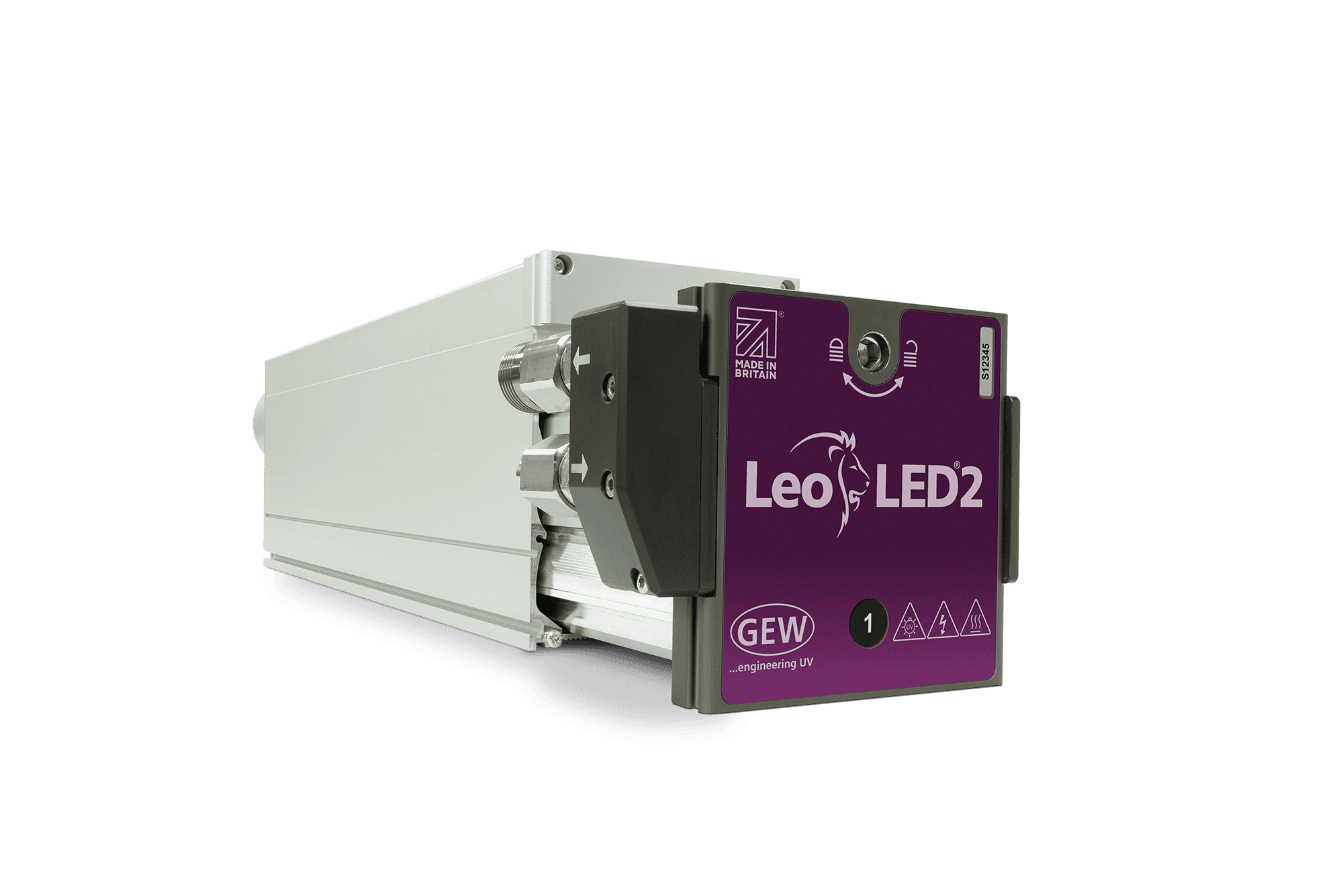
This allows flooring converters to run a hybrid line – using mercury arc for specific traditional coatings while switching to LED for sustainable, high-efficiency runs – all on the same production line. This flexibility removes the barrier to entry for retrofits, allowing flooring plants to move toward a mercury-free future at their own pace.
Energy customisation
LeoLED2 solves the ‘one-size-fits-all’ problem with two distinct power level options. This allows flooring converters to customise their setup based on their specific energy-saving targets and the unique curing requirements of different substrates (from LVT to solid oak), ensuring they only use the power they need while maintaining the world-class process reliability GEW is known for.
Key problems LeoLED2 solves for synthetic floor manufacturers:
- The throughput problem: The 50% increase in UV dose means you don’t have to slow down your line to achieve a full cure on dense synthetic materials or thick wood coatings.
- The heat problem: Unlike mercury lamps, LeoLED2 is water-cooled and emits minimal IR. This prevents wood resins from bleeding, protects heat-sensitive vinyl (LVT/SPC) from warping, and maintains the dimensional stability of the boards.
- The investment risk: ArcLED technology means you aren’t locked in – you can swap between LED and Mercury cassettes in minutes to suit different customer specifications or coating types.
- The regulatory pressure: It provides a high-performance, mercury-free alternative that satisfies impending global mercury legislation and the strict green supplier audits required by major retailers.
E4C
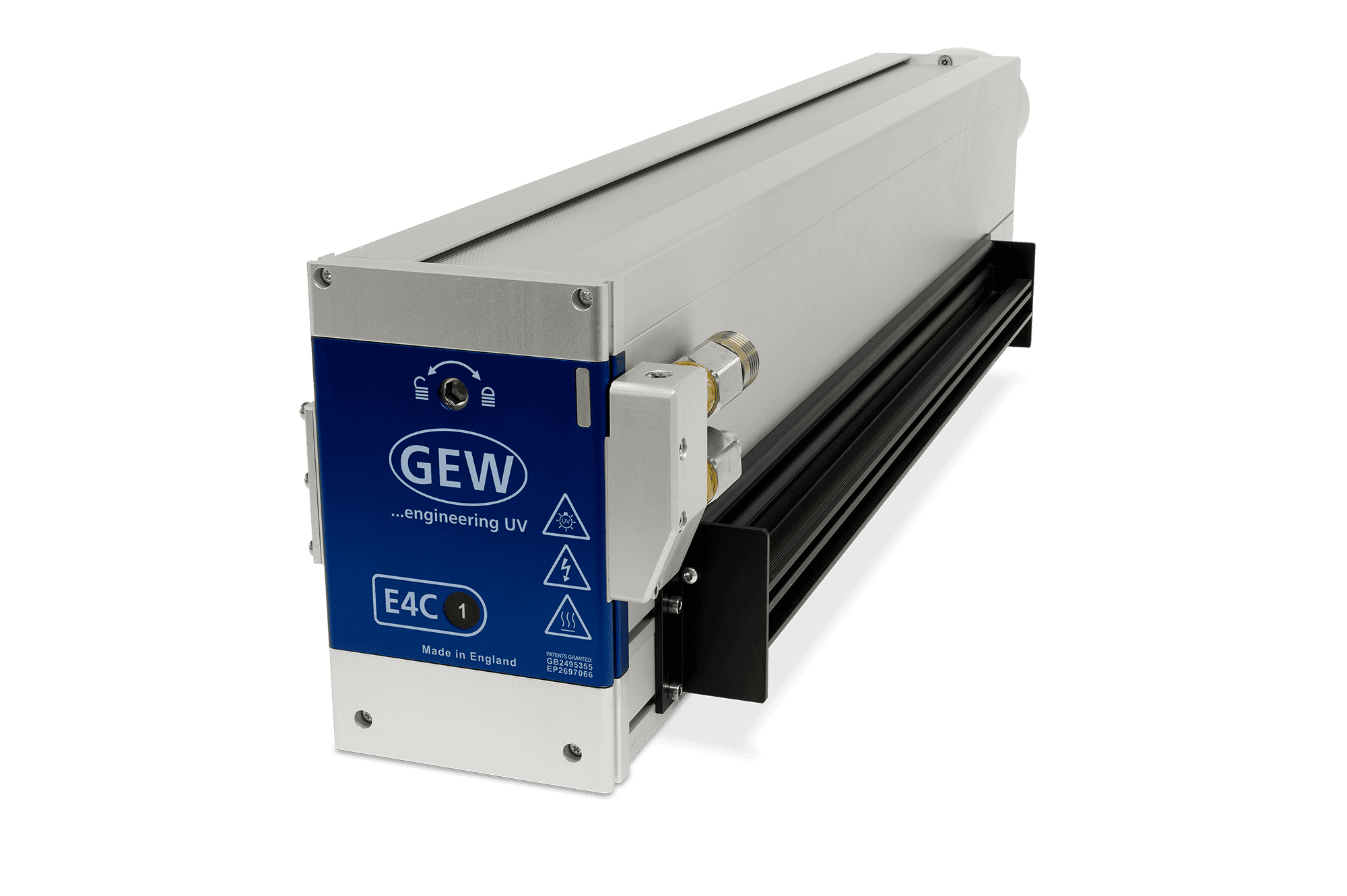
In the parquet industry, production throughput is the primary driver of profitability. However, the heavyweight protective coatings and high-speed lines required for quality wood flooring often demand more curing energy than standard systems can provide. GEW’s E4C solves this by offering the highest power available from our range, specifically engineered to pass the harshest cure procedures and wear-resistance tests at maximum line speeds. Whether you are curing thick anti-scratch primers or high-gloss topcoats on solid or engineered wood, the E4C ensures a full through-cure where other systems might fail, preventing costly bottlenecks on your production line.
Protecting heat-sensitive wood substrates
High-power mercury lamps often carry the risk of overheating the timber, which can lead to warped boards, resin bleeding, or damage to delicate veneers. The E4C eliminates this risk through its advanced water-cooled reflectors. By optically tuning the reflectors to maximise UV output while simultaneously absorbing IR heat, the E4C limits heat transfer to the wood. This makes it the ideal solution for converters working with heat-sensitive veneers or resinous softwoods that require high-intensity curing without thermal damage.
Solving the maintenance and downtime struggle
Downtime on a high-volume parquet coating line is a major profit-killer. The E4C ensures there are no maintenance headaches with a plug-and-play design. Lamp changes are fast and easy, and unlike traditional water-cooled systems, the reflectors can be cleaned or fully replaced without breaking water seals. This reliability keeps your production moving and reduces the need for specialised technical intervention.
The hybrid foundation with ArcLED
For parquet manufacturers who aren’t yet ready for a 100% LED transition due to legacy chemical formulations or specific finish requirements, the E4C provides the perfect future-proof foundation. Powered by the EOS system, it features GEW’s patented ArcLED technology. This allows you to run high-power mercury arc curing today while maintaining the flexibility to swap in LeoLED2 cassettes for specific “green” contracts or future upgrades. It means there is no technology lock-in, giving you a system that adapts to your customers’ changing sustainability requirements and impending mercury legislation.
Key problems E4C solves for synthetic floor manufacturers:
- The slow line problem: Its extreme power allows you to increase line speeds without risking an under-cured finish or failing adhesion tests on thick wood coatings.
- Substrate warping and resin bleed: Water-cooling removes the IR heat that causes timber to bend or natural resins to bleed through the surface.
- Cleaning downtime: The ability to clean reflectors without breaking water seals means maintenance takes minutes, not hours, keeping your floor production on schedule.
- The performance gap: It handles the complex, legacy chemistries and high-build coatings that UV LED might not yet cure as effectively at massive industrial volumes.
ExciRay
In the competitive flooring market – covering parquet, luxury vinyl tile (LVT), and synthetic composites like SPC – achieving a premium soft touch and ultra-matt surface is a high-value differentiator. However, traditional matting agents often lead to polishing (where the matt finish becomes shiny over time due to foot traffic) and reduced chemical resistance.
ExciRay solves this by using dielectric barrier discharge (DBD) lamps to produce 172nm vacuum UV radiation. This specific wavelength triggers a microfolding effect on the very top layer of the flooring lacquer, creating a deep matt finish (down to <2 GU) that is physically part of the coating structure – not an additive that can wear away or be buffed out by cleaning.
Solving the micro-scratch & durability struggle
High-end flooring is prone to unsightly scuffs and surface wear. ExciRay creates a micro-textured surface that naturally provides significantly higher scratch and abrasion resistance than traditional matt coatings. By eliminating the need for silicon matting agents, the final flooring topcoat remains dense and highly cross-linked. This results in no early failure or gloss-drift in high-traffic applications, ensuring the floor maintains its premium aesthetic for years after installation.

A turnkey solution for high-volume flooring lines
Implementing Excimer technology can be daunting due to the requirement for nitrogen inerting and precise process control over wide webs. GEW solves this by offering a completely seamless, turnkey integration. Our ExciRay lamps are available in widths up to 300cm – perfect for wide-format linoleum or vinyl production – and are designed to work in perfect harmony with the wider GEW ecosystem. We provide the full setup, including nitrogen control cabinets and inert chambers, ensuring the system is ‘plug-and-play’ for your flooring production line.
Seamless integration: pre-gelling to final cure
ExciRay is most effective when integrated into a multi-stage curing process. GEW solves the integration headache for flooring manufacturers by coordinating the entire line under a single EOS control platform:
- Pre-gelling: A LeoLED2 station freezes the base of the coating to the substrate.
- Mattification: The ExciRay lamp creates the microfolded, ultra-matt texture in an inert environment.
- Final Cure: A NUVA2 or E4C mercury lamp (or high-power LED) provides the deep through-cure required for industrial wear layers.
By providing all three technologies from a single source, GEW ensures a stable, repeatable process that delivers the same premium, durable finish across every plank and tile.
Key problems ExciRay solves for synthetic floor manufacturers:
- The polishing problem: Unlike chemical additives, the microfolded surface created by ExciRay doesn’t buff or become shiny under the friction of constant foot traffic.
- The aesthetic gap: Achieves dead-flat matt and soft-touch textures that are impossible to reach with standard UV systems, meeting the latest interior design trends.
- The cleaning & mixing headache: Eliminates the need to mix and manage messy matting agents in your coating drums, reducing the risk of batch-to-batch gloss variation.
- The complexity barrier: GEW manages the nitrogen inerting and safety requirements, providing a single point of contact and an easy-to-use touchscreen interface for the entire mattification line.
ArcLED compatibility for synthetic flooring lines

LeoLED2 and E4C are both ArcLED compatible.
ArcLED’s power system allows you to switch seamlessly between mercury arc and LED technologies. Both arc and LED cassettes are compatible with the same power supply and fit in the same housing for ease of change.
To find out more, download our brochure below:
Speak directly to our sales representative

Region, International:
Justas Žvikas
Sales Representative, Wood Coating
Email Justas directly
